HEAT & Operational Safety (Hostile Environment Awareness Training and Operational Safety)
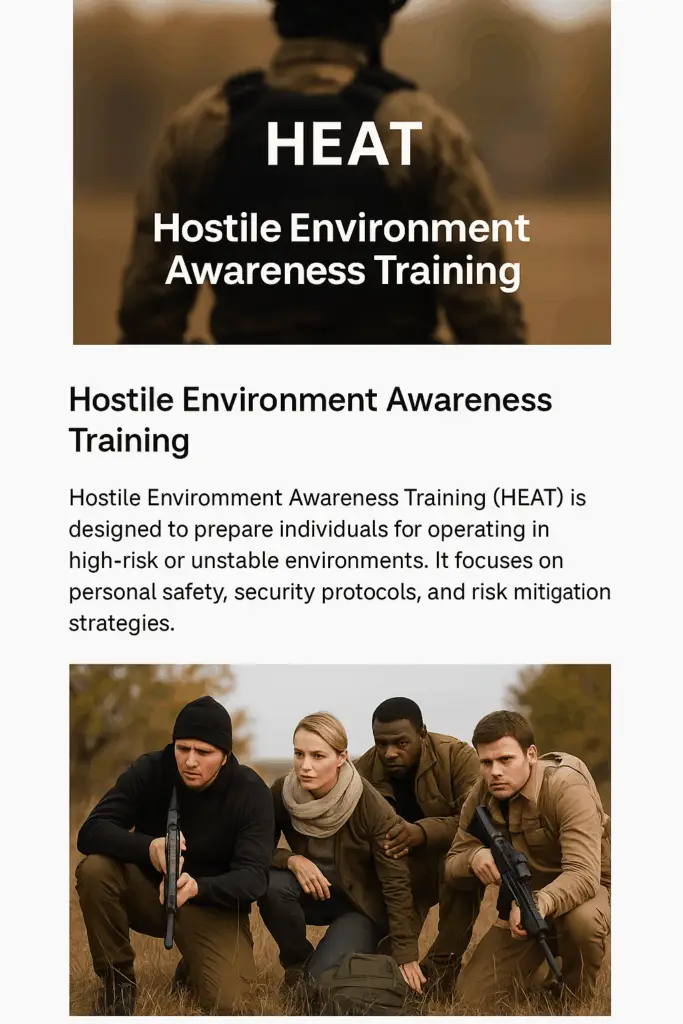
DESCRIPTION OF TRAINING
The training HEAT & Operational Safety (Hostile Environment Awareness Training and Operational Safety)
is aimed at mission personnel selected for deployment to low-, medium- or high-risk environments, or who have recently been deployed on such missions.
These deployments can last from one week to several months, or even up to two years, depending on the operational context, the organisation involved and the nature of the mission.
Ideally, all staff members should have completed a general introductory course on crisis management operations, such as
eBASE or
eSAFE,
or have relevant experience in international field operations.
The training HEAT is developed by
S.M.A.T. based on an operational, realistic approach tailored to mission contexts in sensitive or hostile environments.
Unit 1: Personal Safety Awareness
This unit aims to develop the fundamental instincts needed to identify high-risk situations, reduce personal exposure, and adopt preventive behavior before, during, and after a mission.
- Recognize high-risk situations.
- Identify potential hazards in the immediate environment.
- Adopt preventive behavior suited to the mission context.
Unit 2. First aid in hostile environments
This unit covers the fundamentals of initial medical care in a degraded environment, where access to emergency services may be delayed, limited, or complicated by the security situation.
- Put essential first aid techniques into practice.
- Understand care priorities in different scenarios.
- Adapt the initial medical response to the operational and security context.
Unit 3: Communication and Navigation Tools
This unit introduces the communication and navigation tools commonly used on missions, as well as best practices for maintaining coordination, navigation and safety whilst on the move.
- Identify the main communication tools used in a mission context.
- Understanding the limitations and constraints of communications in sensitive environments.
- Apply the basic principles of navigation, orientation, and route following.
Unit 4: IED, UXO, Mines, Weapons Awareness
This module raises participants’ awareness of the risks associated with improvised explosive devices, unexploded ordnance, mines and the presence of weapons in mission areas.
- Recognise the main indicators of the presence of IEDs, UXOs or mines.
- Understanding how to respond to a threat involving explosives or weapons.
- Develop an appropriate level of vigilance in environments where weapons and explosives are present.
Unit 5. Hostage situations and captivity
This module covers the behaviours, reflexes and survival principles to adopt in the event of a hostage-taking, captivity or detention in a hostile environment.
- Understanding the different stages of a hostage or captivity situation.
- Identify the steps to take to safeguard one’s physical and psychological well-being.
- Behave appropriately when dealing with the kidnappers, intermediaries and the relevant authorities.
Unit 6: Incident Response Training
This module enables participants to practise the expected behaviours during a security incident, an assault, a conflict or an unforeseen situation whilst on a mission.
- Understanding the principles of conflict management in sensitive environments.
- Use appropriate response techniques in the event of an attack or a direct threat.
- To develop reflexes for protection, evacuation and communication in the event of an incident.
Practical information
- Duration :
: 1 to 3 days, depending on demand - Location :
see calendar - Number of participants :
Minimum of 3 to 5 participants depending on the country, maximum of 15 participants. - Languages :
French, English - Certification :
Certificate in: HEAT & Operational Safety By : Security Institute of Ireland (SII). - Prerequisites :
none. - Group :
Sliding-scale rates based on the number of participants and the requested format.
All our group courses can be adapted on request.